Monday, February 16, 2015

MAUS by Art Spiegelman

The book which retells the story of American Cartoonist, Art Spiegleman's Jewish parents surviving the Nazi holocaust in wartime Poland, depicts the Jews as mice and the Germans as cats. Maus is one of the more powerful graphic novels I've read. Even before this course, I read the book in French version. I picked up the book at a comic book shop in Paris and initially loved the cover, I knew for sure there would be some pretty deep content within just seeing the prominence of certain symbols on the cover:

 After reading the book, I was truly affected both artistically/visually and emotionally. Since I had already read Maus, which was recommended for this class, I decided to go ahead and read Spiegleman's book, MetaMaus. I learned in this book that at the time that Maus was made, comics were very different and the holocaust wasn't really ever a topic in comics. People wanted to read about superheroes and lighthearted material. Spiegelman had a purpose with Maus, and that was to create a much more serious visual narrative that was not only personal to him, but to his family, and to many other people who would read it. He wanted to create a story so different from the rest at its time of production that a person would read and remember, and most importantly to be affected by the story he conveys.

In his process of trying to publish Maus, A question often came up: Why Mice? Spiegleman explains in MetaMaus, that the cats and pigs and mice were chosen for quite complex reasons. The jews are not just mice, they're masks, heads, that the characters were wearing to pass through certain boundaries and borders. Like racial 'disguises' or 'badges' to conform to a certain group. Though the characters were associated with very simple and direct symbols (ie. Mice- pest,prey,inferiority- Cats- predator, superiority ), making the choices for those characters involved taking that rhetoric and turning the notion of the subhuman back on itself and letting these 'mice' stand on their hind legs and stand up for their humanity. The idea was based on the concept of 'Exterminating' NOT Murdering, and Spiegleman felt the characters best fit that concept in the sense that mice are depicted to the public as vermin, pests, creatures that cause problems, that do not belong, and must be eliminated as a whole.
                   
His Father collaborated on the book and Spiegelman recorded his memories and experiences through personal interviews. His process took overall 13 years of gathering information and ideas. He mentions that he wanted to make a work worth telling because the drawings are so arduous. I relate so much on so many levels. I relate to his whole approach and idea behind this story. He had the idea  for a moment while working on this, that he should remove himself from the story and write from an objective lens. He realized it would be impossible to tell this story from an objective standpoint. Call it narcissism? But with that approach he decided there would be difficulty transmitting memories. I relate so much to this book and its purpose, not because of the personal experiences Spiegelman and his Father talk about, per-se, and not because of the content itself. I always benefit and grow from learning more about WWII and holocaust stories, especially from personal recounting. But that was not what made me relate so closely to this book. I myself have been working on a story for quite some time. Not 13 years, but as long as I have had the capacity of understanding the war in my country, Lebanon, and have overtime interviews my Father as well. Collecting memories, ideas, stories and physical artifacts from his experiences during the war in the 80's. I have begun my own Graphic Novel called "Lui Qui Traverse" (He Who Crosses) about the war in Lebanon and the division of areas because of Religious segregation. My book is primarily about my Father but also describes the separation him and my Mother had to face because of the circumstances. I know I was heavily influenced by Maus, even in the artwork. I chose to illustrate my book using bold, stark black and white imagery, much like Spiegelman does, and have too been inspired by the art of woodblock printing.


Friday, February 13, 2015

Underground Comix

This may be one of my favorite areas of comics we will touch on in this class. If you were to look at my work and my own comics, you would never know how enthusiastic I actually am about the artists and artwork that came from the Underground Comix movement. A lot of people frown upon Robert Cumb's work. I completely understand the negative reaction his work gets most of the time. As feminist and anti-stereotyping/anti-racism/anti-'pretty much everything Crumb illustrates' I may be, I love every single, awful illustration he does.

Believe me... I wish I could say that I hate this, but I hate it so much I love it.

Half of my collection is made up of Crumb books, because not only do I appreciate the attitude in his work, I admire the flagrant obscenity in his style of drawing. It first reminded me a lot of album covers and show flyers I had always seen in my music collection.


 Along with comics, I grew up on a lot of punk rock and stoner-metal music. I have been totally desensitized to the crass and inappropriate imagery he depicts in his comics. The thing I loved about the Underground Comix was the liberal presentation of X-rated material. Hence the X in Comix. It was, in my opinion, the punk rock of comics. A middle finger to the publications that limited artists and their freedom to be gross and inappropriate. It was aimed at a much more mature and open minded audience, and although at that time, sex, drugs and rock and roll were heavily depicted in comics, Underground Comix took it to an extreme level. I love that!

Wednesday, January 28, 2015

The Comic Strip : 'Krazy Kat'

In this particular section of the class, we had the opportunity to flip through several old and entertaining comic strips compiled into books. Some were very simple and direct, some included optical illusions, and all drawn differently in their own stylized manner. What all of these books had in common was they were all in the form of comical strips - sequential drawings arranged in interrelated panels , often times displaying humor in short, horizontal narratives. I specifically enjoyed the intelligence in the humor and the cleverness of the stories and wording. Though they were mostly about kids or adolescent interactions, and were drawn in an entertaining way for kids to enjoy, the morals and messages of the strips were written in such a way that only an adult could understand or relate to. 


Winsor McCay's Little Nemo, George Herriman's Krazy Kat, and Charles Schultz's Peanuts are examples of some of the pieces we went over this week


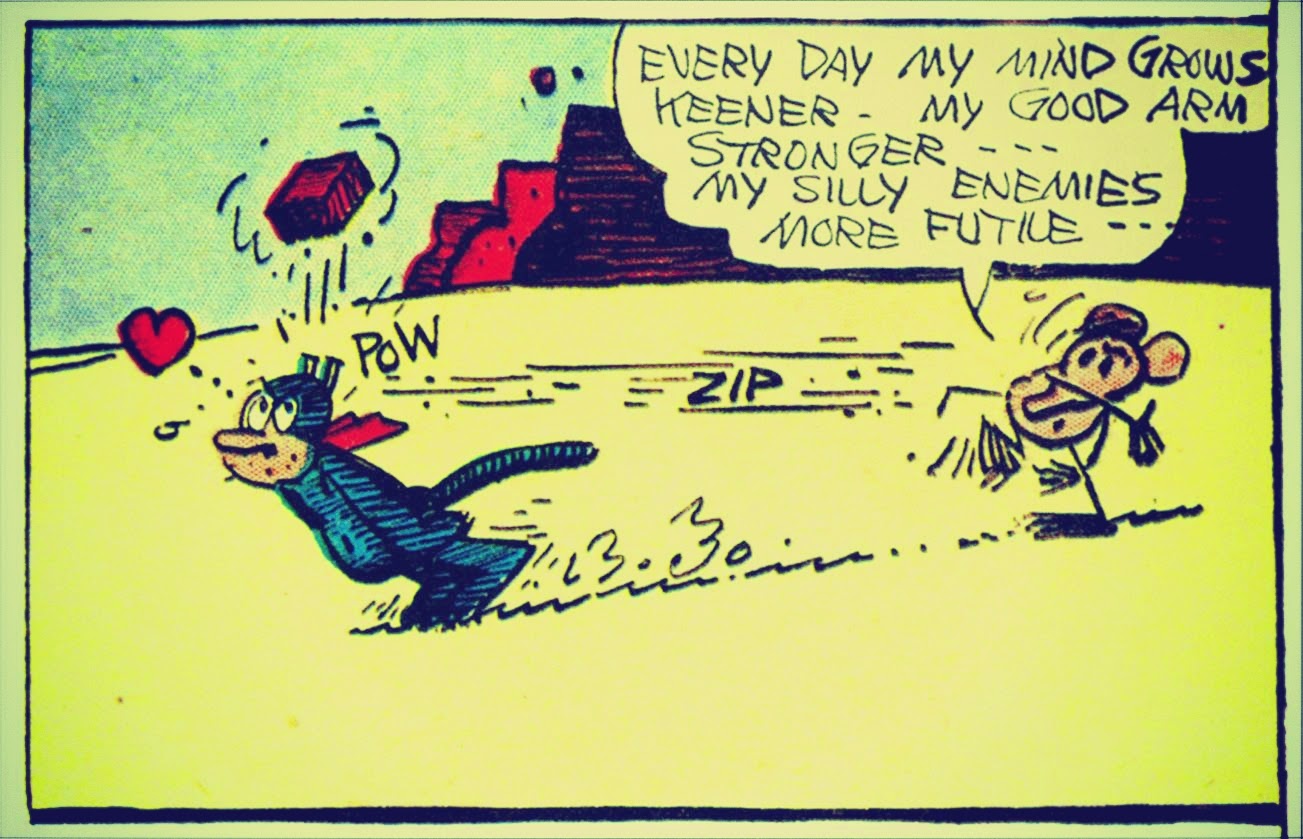
Krazy Kat was definitely one of my favorites (Of the stories I had never heard of or seen prior to this lesson). I was very familiar with Little Nemo and have, since the beginning of my time, been in love with all of the Nemo comics. What I most enjoyed about the Krazy Kat stories is the dynamic of the cat, the mouse and the policeman. The carefree, simple-minded cat named Krazy is of indeterminate gender and is referred to as both "he" and "she", is in love with the grumpy mouse named Ignatz.  Ignatz despises Krazy and is constantly scheming against the cat and always attempting to throw bricks at Krazy's head. At the end of most strips Ignatz is locked in the county jail.It was very reminiscent of the dynamic between Whiley Coyote and Roadrunner. I noticed in a lot of the older comics, police are heavily depicted as the general and easily relatable 'authority figure' and come up a lot in simplistic representations. Like, "if you mess up, the cops are gonna getcha". I found that even thought the stories in the strips were so lighthearted and silly, they represented a lot of greater, adult issues. 


Thursday, January 22, 2015

The Comic Book - Tin-Tin , Blueberry & Hellboy

My father introduced me to comics as a young kid. French comics of course, because that was what he grew up on. One of the first I can remember reading and loving was The Adventures of Tin-Tin , created by HergĂ©. At a younger age this comic really appealed to me. Tin-Tin was a relatively average, intelligent young boy, a reporter, accompanied by his trusty terrier, Milou. His outfit is the same almost entirely throughout the comic, and has very memorable characteristics, like his hairdo and facial expressions. Tintin's iconic representation enhances this aspect. Scott McCloud has said that it "allows readers to mask themselves in a character and safely enter a sensually stimulating world."


 As a child I only enjoyed the adventures for the idea of adventure, but never really understood some of the underlying themes and messages within the stories/surrounding his adventures. Propaganda and publicity stunts were often promoted through the comics. I also never realized some of the more controversial themes like racial stereotypes, animal cruelty, colonialist, violent, and fascist portrayals of nonEuropeans. As we discussed in class, this was justified by HergĂ© as simply being a product of the bourgeois society that surrounded him. Despite all of these corrupt, underlying themes, I loved the simplicity of Tin-Tin and the positive morals and values he represented as a young hero.


Anyway, as I grew out of Tin-Tin, my father introduced me to a different kind of adventure comic. Also a french one, "Lieutenant Mike Blueberry" by Moebius. This was probably the last French comic I avidly read before being introduced to American Comics in the US. I loved the Blueberry stories and the more characters in American comics I have been introduced to the more respect I have for Blueberry as a 'hero'. He never expected reward or acknowledgment for his good deeds or his savings. Blueberry is an atypical western hero, not a wandering lawman who brings evil-doers to justice, nor a handsome cowboy who "rides into town, saves the ranch, becomes the new sheriff and marries the schoolmarm." In any situation, he sees what he thinks needs doing, and he does it. I loved this about him. I was so attracted to this character for this reason. 


I love how honest the back story for Blueberry is. He starts as a dedicated racist (being a product of his family), and is one day saved by an African American, making him a total enemy of discrimination and racism altogether. He fights against the confederates and protects the rights of the Native American people. He was like a western Hellboy for me. I also just really loved the change of artistic style. The complexity of Moebius' artwork and line drawings. His hatched inking style and western colors were so exciting at that age for me. It was like every Blueberry comic I read, felt like a western film, and I wouldn't put it down until I finished reading it. Then onto the next one. It wasn't until I discovered Hellboy in America that I had ever felt that way about a comic. (I will probably talk more about my love for Hellboy in a later post... trust me.)


Tuesday, January 13, 2015

"Understanding Comics", By Scott McCloud

Prior to this class, I hadn't been introduced to Scott McCloud's 'Understanding Comics'. I honestly wish I had been because it could have been VERY useful to my own production of comics much earlier on. A few of the topics addressed in the book that really left an impression on me, were the Transitions, and Time Frames. Of course the Vocabulary of Comics was important and helpful to revise, but in the Transitions and Time Frames chapters, I learned a lot of things about pacing and passage of time in the way that panels are placed and constructed on each page's composition. After going over Shaun Tann's "The Arrival", my mindset had already been in the thoughts of pacing and transitioning panels and pages. I forgot how masterfully done it was in that novel and in so many others. 

McCloud presents the idea of Six forms of Transition:

  1. Idea or purpose – The impulses, the ideas, the emotions, the philosophies, the purposes of the work… the CONTENT.
  2. Form – The form it will take... will it be a book? A chalk drawing? A chair? A song? A sculpture? A pot holder? A comic book?
  3. Idiom – The school of art, the vocabulary of styles or gestures or subject matter, the genre that the work belongs to maybe a genre of its own.
  4. Structure – Putting it all together... what to include, what to leave out... how to arrange, how to compose the work.
  5. Craft – Constructing the work, applying skills, practical knowledge, invention, problem-solving, getting the “job” done.
  6. Surface – Production values, finishing the aspects most apparent on first superficial exposure to the work.


Using a medium or artistic form/structure to properly and successfully tell a story is exactly what these steps made me realize. I have always loved telling stories through comics, but never entirely understood what went into it. A valuable lesson I learned in McCloud's 'Understanding Comics' is also how important the words are, and how along with the drawings and pictures, the words serve as visual elements in representing the story. They serve as design elements like many of the drawings. 

  1. Word Specific- pictures illustrate but don’t significantly add to a largely complete text
  2. Picture Specific- combinations where words do little more than add a soundtrack to a visually told sequence
  3. Duo Specific- panels in which both words and pictures send essentially the same message
  4. Additive- combination where words amplify or elaborate on an image or vice versa
  5. Parallel- combinations, words and pictures seem to follow very different courses without intersecting
  6. Montage- where words are treated as integral parts of the picture
  7. Interdependent- where words and pictures go hand in hand to convey an idea that neither could convey alone

(Page from my Graphic Novel)
"Compression - To stop the bleeding"


Saturday, January 10, 2015

Week of Kindness or The Seven Deadly Element - Max Earnest

Panel 1

A witch casts a spell on chickens eggs
Panel 2
Birdman and chicken look upon dying girl
Panel 3
Chicken man hides girl bellow floor board
Panel 4
Chicken hides baby, kills woman
Panel 5
Chicken man kills woman with joy, other chickens look upon
Panel 6 
Chicken man stares at dancing woman

Friday, January 9, 2015

"The Arrival", by Shaun Tan


It is not obvious, entering this wordless graphic novel, what the story is actually about. The title itself is so powerful and carries so much weight throughout the story. It is depicted in an imaginary world, and uses representative imagery to describe the journey of a man crossing over from one place to another. The panels are so cinematic. Each page is designed and paced like the story boards for a film. The small, squared panels, side by side, move my eye quickly through the page, as my eyes would move in unvarying or fast-moving scenarios in real life (ie. dialogue between two people, taking a vegetable and displaying the motions of chopping that vegetable, panel by panel). The splash pages and larger spreads take significantly longer to process and digest.


I love that about this story. With no words, I am able to visually piece together an entire journey, and as the story unfolds, I realize what it is actually about:

Immigration.


I am not originally from America, and though my transition from Lebanon to the U.S. was completely personal and different from the character in 'The Arrival's experience, I could relate on so many levels to the foreign imagery he encounters. I think the book was intended to empathize with both immigrants and inhabitants of any ambiguous country or place. For those transitioning into a new world, it is intended to show their struggles and to express a possible feeling of loneliness, alienation and confusion. For the inhabitants taking in a foreign immigrant, I think Tan's intention is to remind them of the compassion and acceptance they should have toward those people. The ambiguity of this world he depicts, and the lack of descriptive details and color helps the reader understand and possibly relate to both ends of immigration, the traveler and the receiver. It is so powerful and has greatly influenced the visual story telling in my own comics, with or without words.